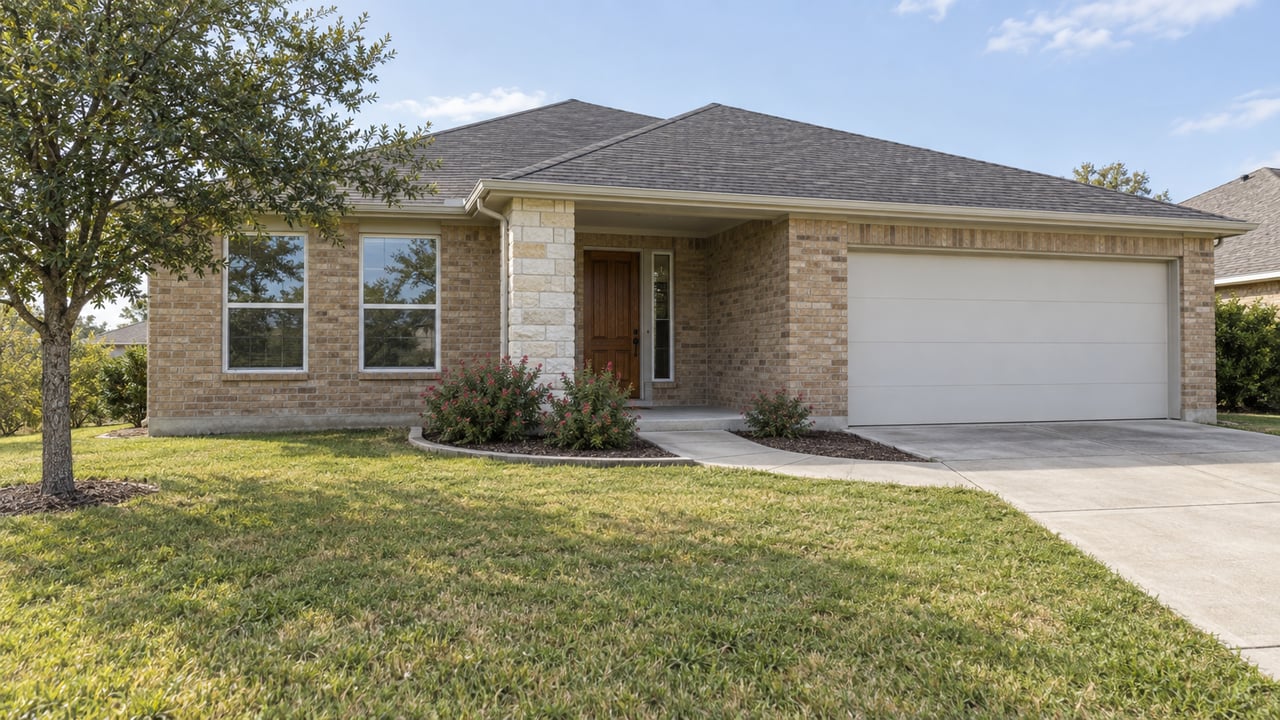
The biggest number on a Temple new-home flyer right now is "4.49%." The fine print turns it into a 5/1 adjustable-rate mortgage. Stylecraft pays for that starting rate on select homes when the loan closes by November 30, 2026. The rate holds for five years and then adjusts every year. Stylecraft's own disclosure puts the APR at 6.879%, assuming the maximum annual adjustment. A few miles away, D.R. Horton is offering a 4.99% fixed-rate FHA or VA loan on certain homes through its affiliated lender, DHI Mortgage. The FHA version carries a 5.697% APR. Freddie Mac's national average for a 30-year fixed loan was 7.28% for the week of October 1, 2026.
If you own a resale home in Temple priced between $200,000 and $300,000, those offers set your real price this fall. A buyer touring your house on Saturday may have toured a model home on Friday. They're comparing monthly payments, and the builder can set its payment in a way most individual sellers can't.
Fewer Listings, Yet Slower Sales
The August 2026 Temple report from the Temple-Belton Board of Realtors contains a puzzle. Months of inventory fell to 5.3, down from 6.6 in August 2025. Over the same period, days on market rose to 123, which is 31 days longer than a year earlier. Closed sales fell 21.8%, to 104 for the month.
A tighter supply usually means faster sales. Temple got tighter and slower at once. When fewer homes are for sale and each one still takes longer to sell, buyers are holding back or buying somewhere these numbers don't fully track.
That second possibility matters. The Texas A&M Real Estate Research Center says its MLS-based figures include new and existing homes that are listed on the MLS. They leave out new homes sold directly by a builder to a buyer outside the MLS. A buyer who walks into a builder's sales office and signs there may never show up in the closed-sales count. Our reading is that builder financing is drawing some of those missing buyers. No published source splits Temple's numbers into new-build and resale, so treat that link as an interpretation. It isn't a measurement.
The Price Band Where It All Collides
In August 2026, 52.5% of Temple's closed sales landed between $200,000 and $299,999. Another 19.2% fell between $300,000 and $399,999. Builders in Temple are pricing move-in-ready homes in that same bracket and cutting prices too:
- At D.R. Horton's Pepper Creek Crossing, 14 homes are listed. One is 1734 Rapids Drive, reduced from $227,000 to $211,500.
- At Stylecraft's South Pointe, 1916 Meridian Loop is a move-in-ready home reduced from $278,300 to $264,900.
- At Lennar's The Ridge at Knob Creek, homes on Wolf Ridge Lane were listed at $220,999 and $245,999 under a Fall Super Sale. That sale offered up to $20,000 off for contracts signed September 28 through October 4, 2026.
So a resale home at Temple's August median of $253,000 lands right in this group. A buyer could choose a new home with a price cut and a subsidized rate, or yours at market financing.
What a 4.99% Rate Is Worth in Sticker-Price Terms
Take a $250,000 loan on a 30-year fixed term and look at principal and interest only. At 7.28%, the payment is roughly $1,711 a month. At 4.99%, it's roughly $1,340. That's a gap of about $370 every month. To bring the 7.28% payment down to $1,340, the loan would have to shrink to about $196,000. That works out to a price cut of roughly $54,000 on a home in the low $250,000s.
These figures are our own arithmetic. They leave out taxes, insurance and mortgage insurance, and every buyer's actual rate depends on credit and loan type. Still, the scale explains the August numbers. A $10,000 reduction on a resale listing barely moves the monthly payment next to a builder rate that is more than two points below the national average. For a payment-focused buyer, the builder's offer can look several times larger than any price cut a typical seller would consider.
The Offers, Fine Print Included
| Builder | Headline offer | What the disclosure says | Deadline |
|---|---|---|---|
| D.R. Horton, Pepper Creek Crossing and other Temple communities | 4.99% fixed, FHA or VA | FHA APR 5.697%, VA APR 5.142%; must use DHI Mortgage; may require the borrower to pay points; available until the rate pool runs out | Contract on or after 9/19/26, close by 12/31/26 |
| Stylecraft, including South Pointe | 4.49% starting rate, or up to $20K "Your Way" | 5/1 ARM; APR 6.879% assuming maximum adjustment; must use Kangaroo Home Lending; minimum 680 credit score | Loan closed by 11/30/26 |
| Lennar, The Ridge at Knob Creek | Up to $20,000 price reduction | Select homes only | Contract 9/28–10/4/26, close by 10/23/26 |
The Stylecraft disclosure explains how the ARM works after year five:
"Initial interest rate adjustment cannot change more than 1%, and thereafter, each subsequent periodic interest rate adjustment cannot change more than 1%. Rate increases are capped at 5% for the life of the loan."
These terms matter to resale sellers for two reasons. First, the headline rate and the long-term cost aren't always the same thing, and a well-informed buyer will compare the APRs. Second, the D.R. Horton fixed-rate offer is close to its advertised number, and its APR is far below the 7.28% average. A resale listing in Pepper Creek Crossing's price range is competing with that offer until December 31.
Builders can also change these offers without notice. D.R. Horton's terms depend on a pool of funds that can run out, and Stylecraft says its incentive may change at any time. The table above shows the terms as of early October 2026.
The Pipeline Isn't Slowing
Builders are still adding homes. In the City of Temple's weekly permit register for September 25 to October 1, 2026, 11 new single-family applications were listed. Five name Stylecraft, five name Omega Builders and one names Flintrock Builders. All 11 were at plan review, so these are future homes, not finished ones. At Pepper Creek Crossing alone, the Temple Daily Telegram reported a final plat for 292 lots on 75 acres, including 287 single-family lots.
A steady flow of new homes keeps builders motivated to sell the ones already finished. Finished homes are where most of the financing offers and price cuts in this post apply.
What a Resale Seller Can Put on the Table
A resale seller can't lock in a pool of discounted mortgage money the way a large builder can. The tool builders use is still open to anyone, though. Federal rules already allow for seller-paid help with a buyer's rate.
The Consumer Financial Protection Bureau describes a temporary buydown: the buyer gets lower payments for a set period, usually one to three years, and the payment steps up each year until the buydown ends. Under the CFPB's Regulation Z commentary, a seller can pay for that subsidy, and the payment appears as a seller credit on the closing documents. Freddie Mac's Seller/Servicer Guide requires the buydown to be fully funded at closing and the loan file to show the total cost. So the cost is a specific dollar amount that the buyer's lender calculates. There's no standard fee you can quote ahead of time.
For a Temple listing in the $200,000s, that leads to a different pricing approach:
- Show the payment before the price. Ask a lender to quote a monthly payment on your home with a seller-funded buydown. Compare it with the builder payments a buyer has likely seen.
- Compare the cost of a buydown with an equal price cut. The same dollars can lower a buyer's payment more through a buydown than through a reduction, depending on the loan.
- Know the limits. Even Stylecraft's disclosure says its offer is "not to exceed seller concession limits." Resale sellers face caps too. Fannie Mae's guide on temporary buydowns says its interested-party contribution limits apply when a party to the sale pays for the buydown.
- Lead with what a new home can't offer. These incentives sit on homes in new subdivisions. An established lot, mature landscaping or a location close to town are features a builder can't add with a rate offer.
None of this is financial or tax advice. The right mix of price, concessions and timing depends on your loan, your equity and the buyer's lender.
FAQ
When will September 2026 numbers for Temple be out? As of October 4, the newest Temple report on the board's site covers August 2026. The Texas A&M Real Estate Research Center says markets outside Houston release data around the 20th day after a month ends. That puts September figures around October 20.
Do builder sales show up in Temple's market reports? Only when the home is listed on the MLS. Sales made directly between a builder and a buyer are left out.
Does a buyer have to use the builder's lender? No. Both D.R. Horton and Stylecraft say buyers can finance anywhere. They only get the advertised rate if they use the builder's chosen lender.
If you plan to list a Temple home this fall, Rachel Holman can price it against the builder offers buyers are seeing now, side by side, payment to payment, and show you whether a buydown or a price cut does more for your bottom line. Start with your Free Home Valuation.